SpudScout / Disease Guide
25 entries · offline-first · in your pocket

A pocket reference for every potato disease a scout will meet.

Every entry in the SpudScout guide includes symptoms, disease cycle, management, and look-alikes — built for thumb-flicks between rows, not desktop reading. Here's a tour of what's inside.

01 · Foliar Diseases

What the leaves are telling you.

Late blight can defoliate a field in three weeks. Early blight reads as concentric rings; white mold spreads from senescing flowers. Every foliar entry pairs sharp field photos with the lifecycle clues that separate look-alikes.

Oomycete Fungus Bacterium
Entries08
Sections4
Field photos40+
Late Blight Phytophthora infestans01
Early Blight Alternaria solani02
White Mold Sclerotinia sclerotiorum03
Gray Mold Botrytis cinerea04
Verticillium Wilt Verticillium dahliae05
Brown Spot Alternaria alternata06
Black Leg Pectobacterium spp.07
PVY & Mosaic Potato Virus Y08
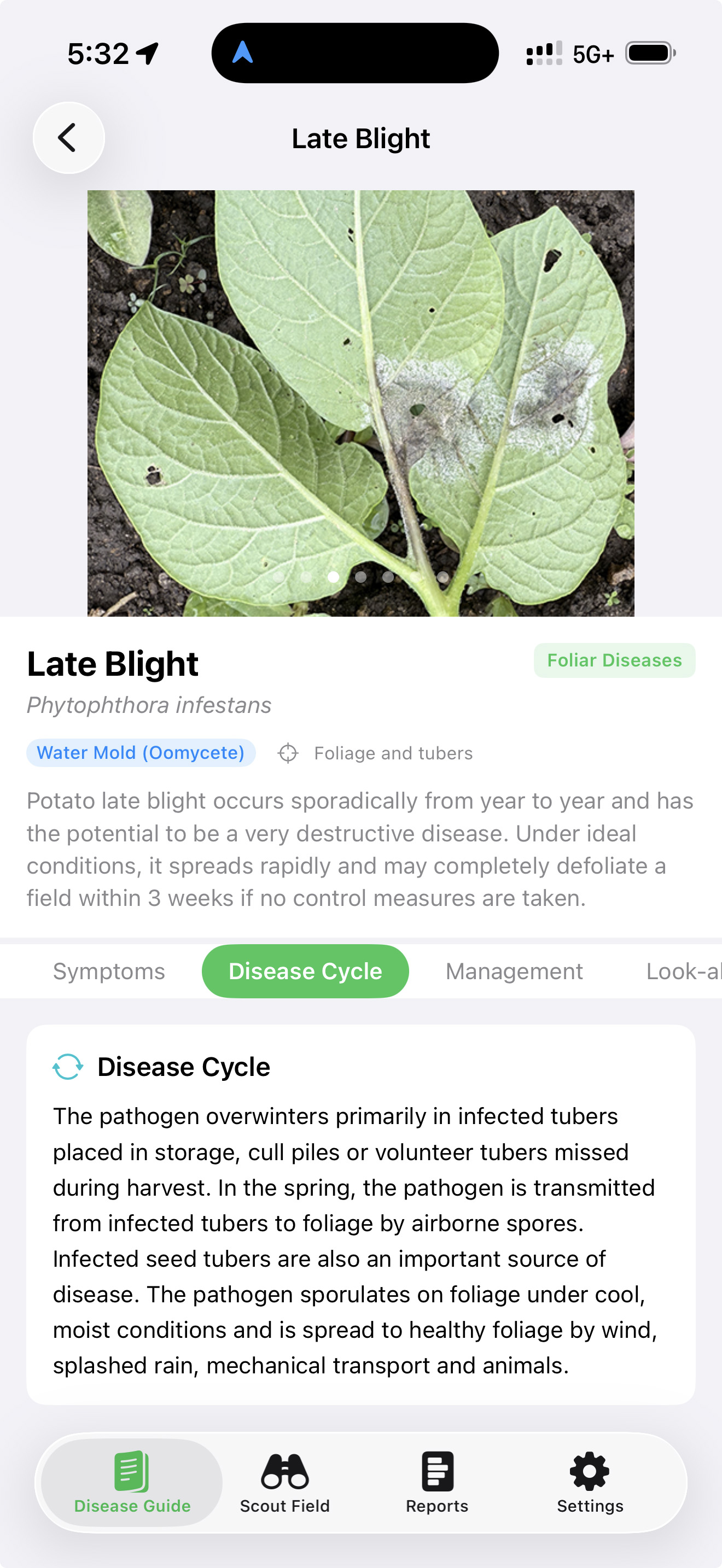
SpudScout disease guide entry for Late Blight, showing a leaf with sporulating lesions and the Disease Cycle tab open
Late Blight · Disease Cycle Foliar entry · 6 field photos
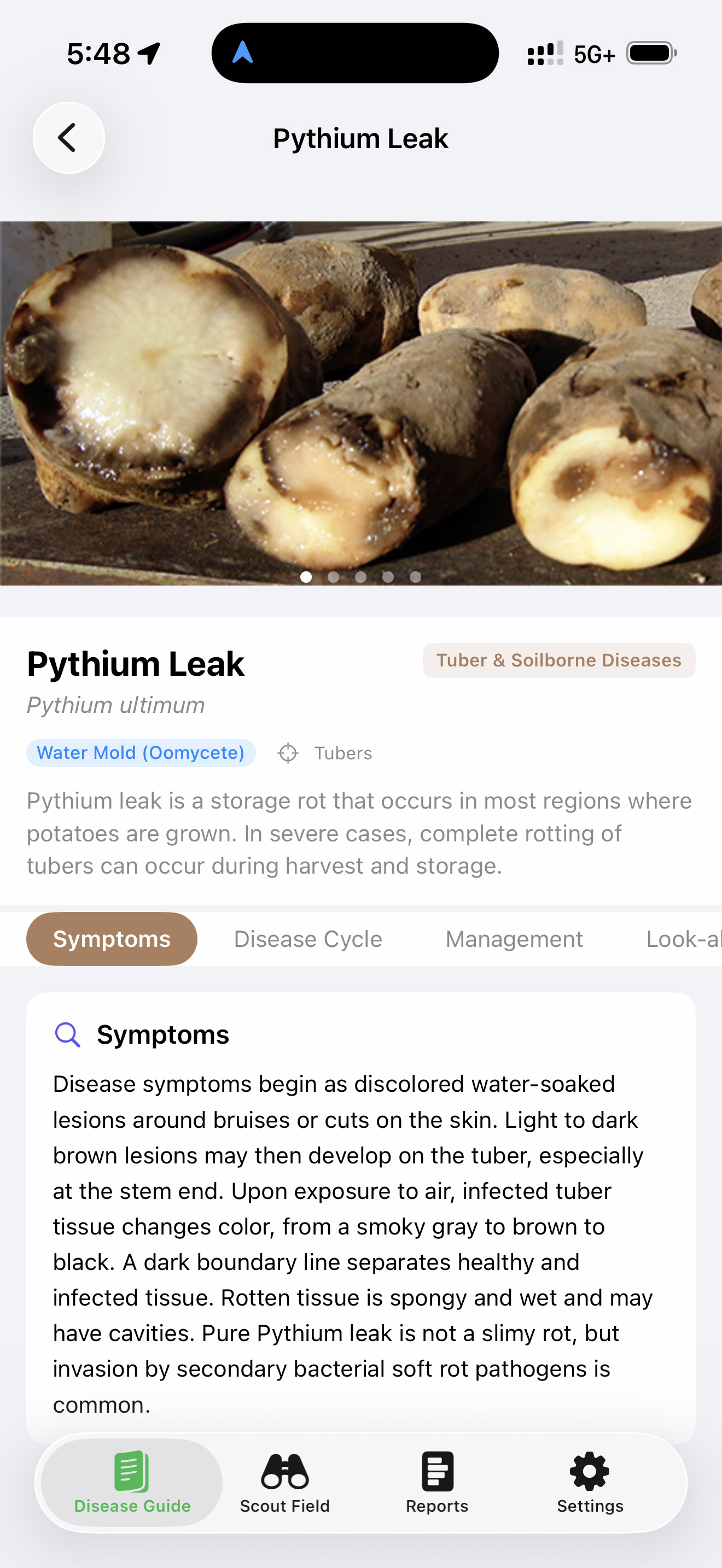
SpudScout disease guide entry for Pythium Leak, showing tubers cut open with characteristic spongy brown rot
Pythium Leak · Symptoms Tuber & Soilborne · 5 field photos
02 · Tuber & Soilborne

The diseases you don't see until lift.

Common scab, blackleg, pink rot, rhizoctonia — many of these only show themselves at harvest or in storage. The guide cross-references symptom photos against soil and storage conditions, so a scout can call it correctly before a lot ships.

Fungus Bacterium Water Mold Streptomyces
Entries10
Storage flags6
Field photos50+
Pythium Leak Pythium ultimum01
Common Scab Streptomyces scabies02
Black Dot Colletotrichum coccodes03
Blackleg Pectobacterium spp.04
Rhizoctonia Rhizoctonia solani05
Pink Rot Phytophthora erythroseptica06
Silver Scurf Helminthosporium solani07
Fusarium Dry Rot Fusarium spp.08
Soft Rot Pectobacterium carotovorum09
Powdery Scab Spongospora subterranea10
03 · Physiological Disorders

Not a pathogen — but it'll still cost you.

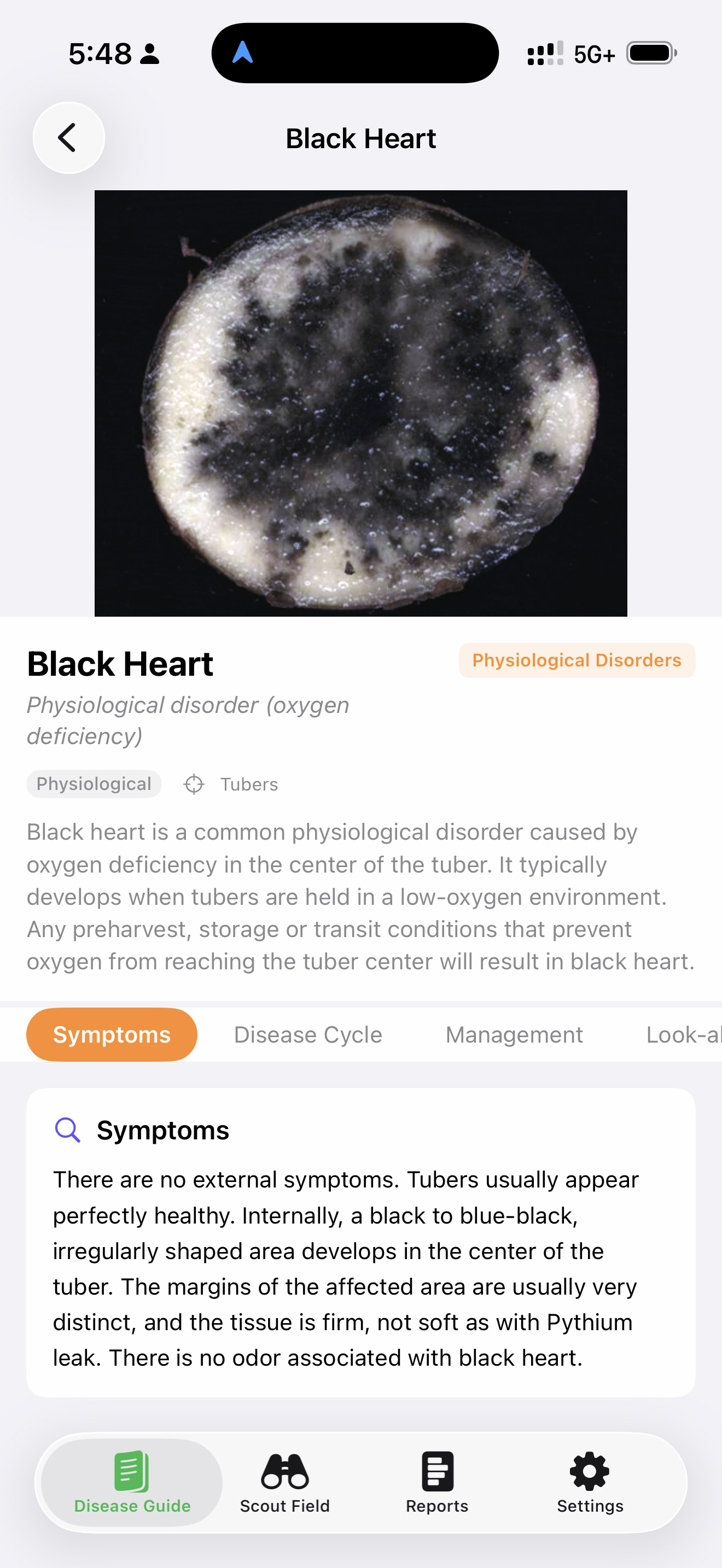
Hollow heart, black heart, internal brown spot, growth cracks: physiological disorders come from oxygen, temperature, and water — not microbes. The guide walks scouts through cause, prevention, and the look-alikes that get them confused with rot.

Oxygen Temperature Water
Entries04
Cause-driven100%
Field photos16
Hollow Heart cell tear01
Black Heart O₂ deficiency02
Internal Brown Spot Ca deficiency03
Growth Cracks moisture surge04
SpudScout disease guide entry for Black Heart, showing a cross-sectioned tuber with characteristic blue-black core from oxygen deficiency
Black Heart · Symptoms Physiological · O₂ deficiency
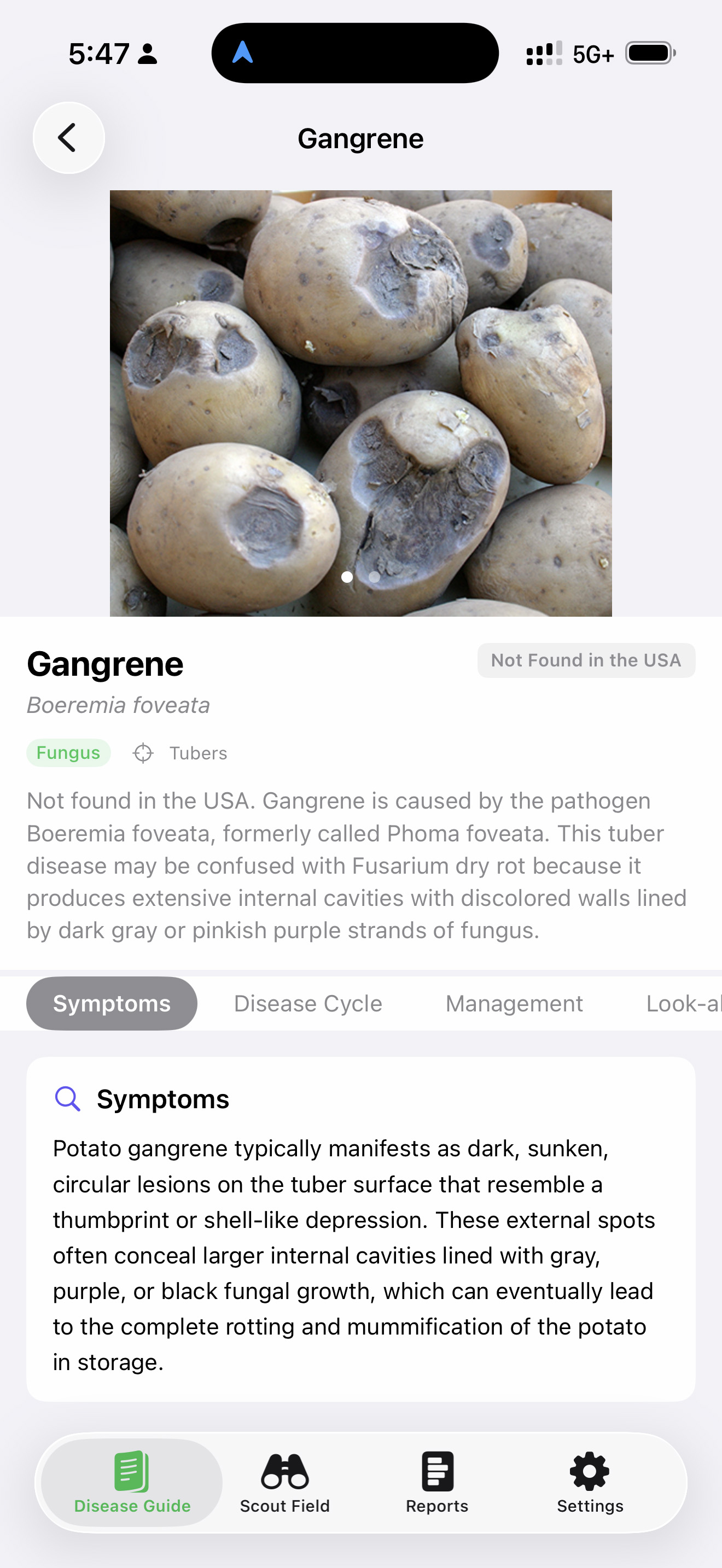
SpudScout disease guide entry for Gangrene, flagged as Not Found in the USA, showing thumbprint-shaped sunken lesions on tubers
Gangrene · Not Found in USA Quarantine flag · 2 reference photos
04 · Not Found in the USA

For scouts who cross borders.

A short reference set for pathogens not currently established in the United States — included so scouts working international fields, or vetting imported seed, can spot them and flag them. Every entry is clearly marked as a quarantine concern with look-alikes inside the US guide.

Quarantine Reference only
Quarantine reference Entries in this section are flagged in the app and excluded from US-region default search. Scouts can opt in to international mode in Settings.
Gangrene Boeremia foveata01
Pale Cyst Nematode Globodera pallida02
Brown Rot Ralstonia solanacearum03
SpudScout app icon
All 25 entries · in your pocket · offline

The full guide is in the app.

This page is a tour. The full searchable guide — with disease cycle, management notes, and side-by-side look-alikes — lives in SpudScout Pro.